
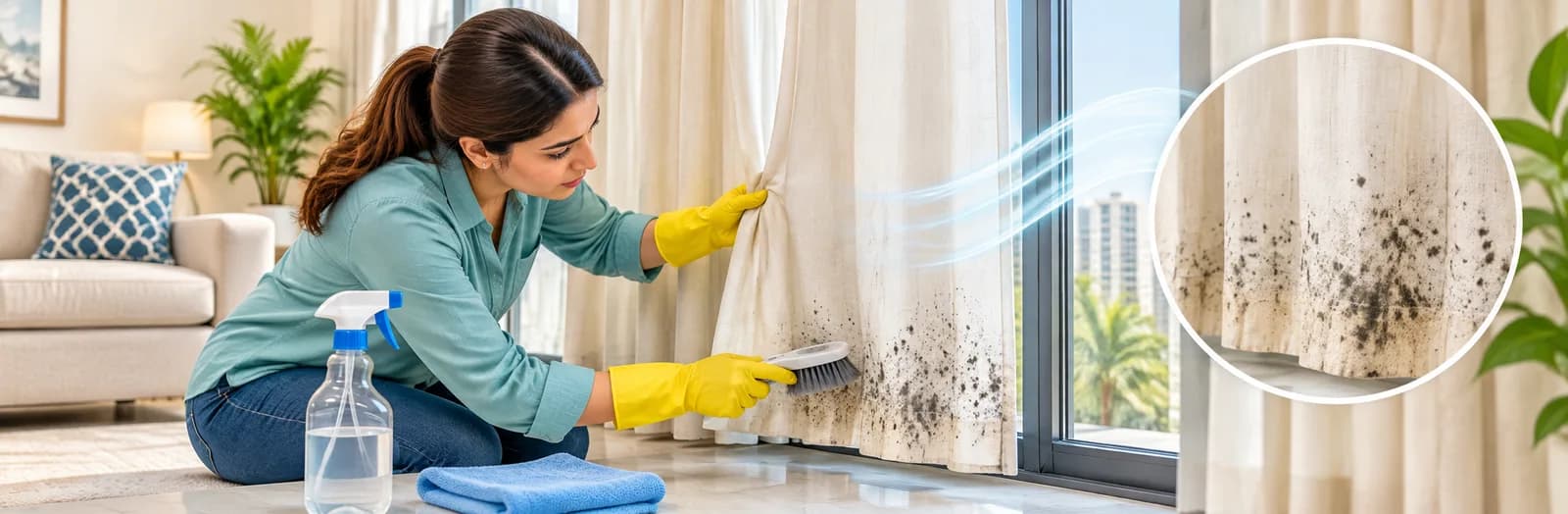
You pull the curtains back and spot grey or black specks along the hem. Or there's a musty smell in the room that wasn't there last month. Mould on curtains is common in UAE homes, where humid air, AC condensation and curtains pressed against cool windows give it everything it needs.
The good news is that most curtain mould comes out if you catch it early. The catch is that the wrong method can do more harm than the mould itself. Chlorine bleach on coloured cotton, a hot wash on blackout curtains or a hard scrub on velvet can ruin them for good.
This guide shows you how to remove mould safely, fabric by fabric, and how to stop it coming back.
Quick answer: Take the curtains outside and brush off the loose mould with a soft brush. Check the care label and test your cleaner on a hidden spot. Spray the mould with a 1:1 mix of white vinegar and water and leave it for 30 to 60 minutes. Then wash on a gentle cycle at the warmest temperature the label allows, or spot-clean if the curtains aren't washable. Dry them completely before you rehang them, and fix the source of the damp.
Before You Start: Safety and Prep
Mould releases spores when you disturb it, so a few minutes of prep protects you and the rest of your home.
- Protect yourself. Wear rubber gloves and an N95 or FFP2 mask. Add goggles if you'll be spraying overhead.
- Work outside. A balcony, terrace or garden keeps spores from settling on your sofa, carpets and bedding.
- Read the care label. A washtub symbol means it's washable. A circle means dry clean only. A crossed-out triangle means no bleach of any kind.
- Patch test. Try every cleaner on a hidden spot, such as the back of a side hem. Wait 15 minutes and check for fading or water marks.
- Never mix chemicals. Chlorine bleach mixed with vinegar or ammonia releases toxic gas. Don't combine hydrogen peroxide and vinegar in the same bottle either. Use one product, rinse, then use the next.
Is it mould or mildew?
Mildew is flat, powdery and white or grey, and sits on the surface. Mould is fuzzy or slimy, often black or green, and grows into the fibres. Mildew usually brushes off and washes out easily. Mould needs the full treatment below.
How to Remove Mould from Washable Curtains (Step by Step)
Use this method for most cotton, polyester and sheer curtains with a washtub symbol on the label.
Step 1: Take them down. Remove hooks, rings and any curtain weights so nothing snags or rusts in the wash.
Step 2: Brush off the loose mould outdoors. Use a soft-bristled brush or a vacuum with a brush attachment (ideally one with a HEPA filter). Many guides suggest a stiff brush, but it roughens the fibres and pushes spores deeper into the weave. Empty the vacuum outside straight away.
Step 3: Pre-treat the stains. Mix white vinegar and water 1:1 in a spray bottle. Spray the mouldy areas until damp, not soaking, and leave for 30 to 60 minutes. For stubborn marks on white or light, colourfast fabric, dab on 3% hydrogen peroxide instead and leave it for 10 to 15 minutes. You can also soak them in oxygen bleach (not chlorine bleach) using the dose on the pack.
Step 4: Wash gently. Use a delicate cycle, a mild detergent and the warmest temperature the care label allows. That's usually 30 to 40°C. Use 60°C only for white cotton or polyester whose label permits it. Add one cup (about 250 ml) of white vinegar to the fabric softener drawer to help kill remaining spores and the musty smell. Wash large panels one or two at a time so they rinse properly.
Step 5: Dry completely. Line-dry outdoors. Sunlight helps kill mould and lifts odours, but the UAE sun is strong. Dry whites and light polyester in the sun, and put dark, dyed, linen or silk-blend curtains in the shade. Only tumble dry on low if the label allows it. Don't rehang until the curtains are fully dry, including the hems and the thick heading tape.
Step 6: Inspect and repeat once. Faint grey shadows sometimes remain. A second pre-treat and wash often clears them. If they're still there after two rounds, the mould has likely stained the fibres permanently.
How to Remove Mould from Curtains Without Washing
Use this method for dry-clean-only, lined, interlined and velvet curtains, or for panels too heavy to take down.
- Vacuum both sides with a brush attachment. If the curtains are still hanging, lay an old sheet below to catch spores.
- Mix a gentle solution. Use one teaspoon of mild liquid detergent in 500 ml of lukewarm water, or white vinegar and water at 1:4.
- Dab, don't rub. Use a clean microfibre cloth. Work from the outside of the stain inwards so it doesn't spread. Rubbing distorts the weave and crushes the pile.
- Blot out the cleaner with a second cloth dampened in plain water.
- Dry fast. Open the windows, point a fan at the fabric or run a dehumidifier. Fabric that stays damp for more than a day or two can grow mould again.
Don't spot-clean silk yourself. Water and vinegar can leave permanent rings on it. Send silk curtains to a dry cleaner or book a professional curtain cleaning service.
Fabric-by-Fabric Guide
| Curtain fabric | Safe to use | Avoid | Best method |
|---|---|---|---|
| Cotton | White vinegar, mild detergent, oxygen bleach (if colourfast) | Chlorine bleach on coloured cotton | Pre-treat, then machine wash at 30–40°C (60°C for whites if the label allows) |
| Polyester, sheers and net curtains | White vinegar, oxygen bleach | Hot washes and hot tumble drying, which set creases and can yellow them | Soak for 1 hour in cool water with 1 cup of white vinegar, then a gentle 30°C wash |
| Linen | Diluted vinegar, mild detergent | Hot water (shrinks it), hard scrubbing | Cool gentle wash or dry clean, then dry in the shade |
| Velvet | Soft brushing, light vacuuming | Soaking, rubbing against the pile | Brush in the direction of the pile, then dry clean |
| Silk | Nothing at home | Vinegar, peroxide, direct sun | Professional dry clean only |
| Blackout and thermal-backed | Mild detergent, 1:4 vinegar spot-clean | Hot washes, tumble drying, ironing the coating, wringing | Spot-clean, or a cool gentle wash if the label allows. Line dry. |
| Lined or interlined | Spot-cleaning only | Machine washing (the layers shrink at different rates) | Spot-clean, then professional cleaning |
Common Mistakes That Damage Curtains
- Reaching for chlorine bleach. It strips colour, weakens natural fibres and often only lightens the stain on porous fabric without killing the mould inside it.
- Scrubbing hard. Stiff brushes and hard rubbing cause pilling, thinning and crushed pile.
- Washing blackout curtains hot. Heat cracks the foam or acrylic coating, which then flakes and lets light through.
- Leaving dark curtains in the midday sun. Strong UAE sunlight can fade dyes and weaken silk and linen quickly.
- Rehanging them slightly damp. Damp curtains next to a cool window will grow mould again within days.
- Cleaning the curtains but not the cause. If the room is still humid, the mould will be back.
Why Mould Keeps Coming Back (and How to Stop It)
Mould needs moisture, so prevention is all about keeping curtains dry.
- Leave a gap between curtains and glass. Condensation collects on windows and glass doors, especially overnight with the AC running. Curtains that touch the glass soak it up. Open the curtains each morning to let them air out.
- Check your AC. A leaking AC unit near a window can keep curtains damp without you noticing. A dirty unit can also blow mould spores around the room. Learn the difference between AC cleaning and AC duct cleaning to know which one your home needs.
- Control humidity. Aim to keep indoor humidity between 30% and 50%, and below 60%. A dehumidifier helps in bedrooms, and an extractor fan helps in bathrooms and kitchens. Avoid leaving balcony doors open on humid days.
- Clean little and often. Vacuum curtains every week or two with a brush attachment, and give them a full clean every 3 to 6 months. Check the hems and the back of linings often during the humid summer months.
- Check other soft furnishings. If your curtains have mould, the room's humidity is probably affecting your sofa and mattress too. See our guides on how to clean a couch at home and removing dust mites in your mattress.
When to Call a Professional (or Replace the Curtains)
DIY works well for small, recent spots on washable fabric. Call a professional when:
- The curtains are silk, velvet, lined, interlined or dry clean only.
- The mould covers large areas or keeps coming back after two treatments.
- Someone at home has asthma, allergies or a weakened immune system.
- There's also mould on walls, window frames or the AC, which points to a bigger moisture problem.
It's time to replace the curtains if the fabric has thinned, crumbles or tears easily, if the musty smell remains after professional cleaning, or if they were soaked by a leak for several days.
Care N Clean helps homes in Dubai and across the UAE with curtain cleaning, deep cleaning, professional sofa cleaning and AC servicing, the services that deal with mould and the damp that causes it. Browse our cleaning services or get a free quote.