
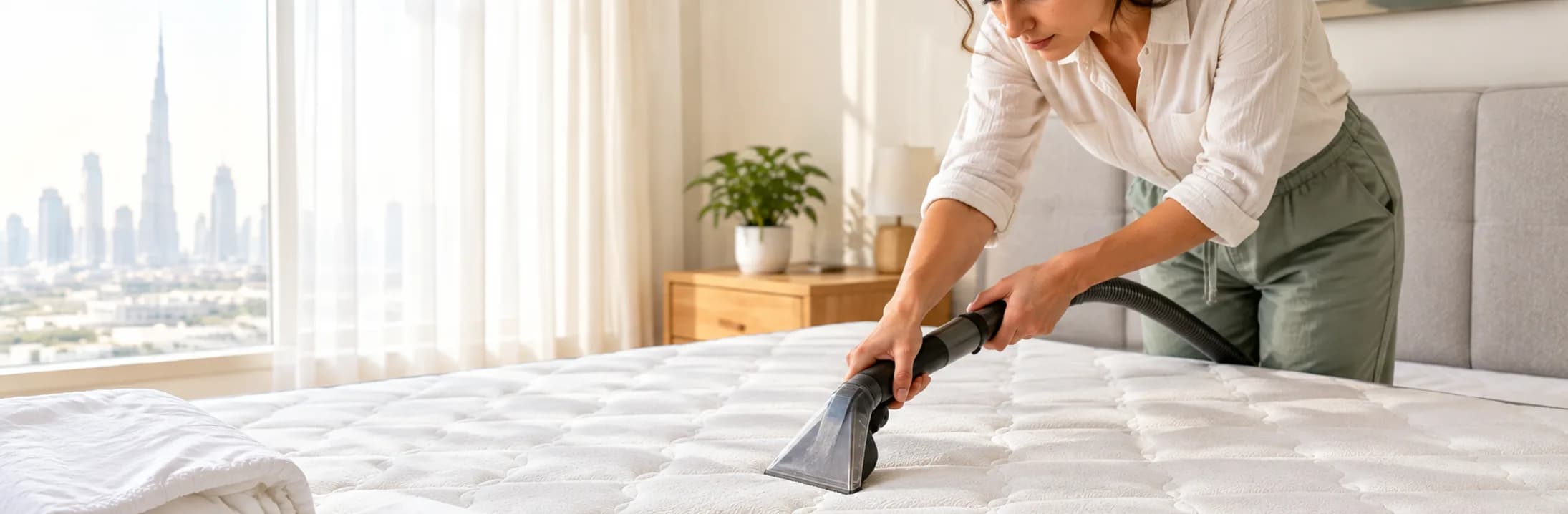
If you wake up congested, sneezing or with itchy eyes and it clears an hour after you get out of bed, the problem is probably not the weather or a cold. It is what is living in your mattress.
Dust mites are microscopic relatives of the spider, far too small to see, and a used mattress can hold tens of thousands of them. They do not bite and they carry no disease. What they do is shed waste particles, and those particles are one of the most common indoor allergy triggers in the world.
The frustrating part is that you cannot clean them out in the way you would clean a stain. There is no spray that reaches into foam and kills a colony, and most of the advice online — essential oils, freezing, sprinkling things and hoping — does very little. What actually works is a short list of unglamorous measures, and the most effective one has nothing to do with cleaning at all.
This guide covers how to remove dust mites from a mattress properly: how to confirm that is what you are dealing with, how to tell dust mites apart from bed bugs, the step-by-step method that genuinely reduces them, the popular remedies that waste your time, and why Dubai bedrooms make the problem worse.
What Dust Mites Actually Are
Dust mites are tiny arachnids, roughly a quarter of a millimetre long, which puts them just below what the human eye can resolve. They live in soft furnishings wherever three things are available: warmth, humidity and food.
Their food is you. Specifically, the dead skin cells that every person sheds continuously, around one to one and a half grams a day. A mattress collects that shedding for eight hours a night, every night, for years.
What do dust mites look like?
Translucent, eight-legged and about 0.25 mm long. You will not see them without a microscope, and anything you can see crawling on your mattress is not a dust mite — it is something else, and worth identifying properly.
What you might notice instead is the dust itself. Household dust is largely made of shed skin and fabric fibres, and in a bedroom a significant fraction of it is mite waste and mite fragments.
Do dust mites bite?
No. This is the single most common misconception, and it matters because it changes what you should do next.
Dust mites have no interest in living humans and no mouthparts capable of biting. They eat dead skin that has already flaked off. If you are waking up with actual bite marks, dust mites are not the cause and you should read the comparison further down this page.
What dust mites cause is an allergic reaction. The allergens are proteins found in their droppings and in the fragments of dead mites, both of which become airborne when you move around on the bed. You breathe them in, and if you are sensitised, your immune system responds.
How to Tell If You Have Dust Mites in Your Mattress
There is no test you can run at home and nothing to look for on the surface. The diagnosis is made from symptoms and from their timing.
Signs that point to dust mites
- Congestion, sneezing or a runny nose on waking that eases through the morning.
- Itchy, red or watering eyes in bed or shortly after lying down.
- A cough or wheeze that is worse at night and better during the day.
- Symptoms that improve when you sleep elsewhere — a hotel, a relative’s house.
- Eczema or skin irritation that flares on the areas in contact with bedding.
- Year-round symptoms rather than seasonal ones, which separates mites from pollen.
- Worse symptoms when changing the sheets or vacuuming, as allergen is disturbed into the air.
That last one is a useful clue. If stripping the bed reliably sets off a sneezing fit, the allergen is in the bedding.
Dust mites or bed bugs?
These get confused constantly, and the treatments have nothing in common. One is an allergen problem you manage; the other is an infestation you eradicate.
| Dust mites | Bed bugs | |
|---|---|---|
| Visible to the eye | No, about 0.25 mm | Yes, 4–5 mm, like an apple seed |
| Do they bite? | Never | Yes, usually in lines or clusters |
| What they eat | Shed skin flakes | Blood |
| Where they live | Throughout the mattress and bedding | Seams, buttons, bed frame, headboard |
| Visible evidence | None | Dark spots, shed skins, blood specks on sheets |
| Main symptom | Allergy: sneezing, congestion, wheeze | Itchy raised bites |
| Smell | None | Sometimes a sweet, musty odour |
| Solution | Reduce and manage, ongoing | Professional eradication |
If you are finding bites, dark specks along the mattress seams or insects you can actually see, stop here — that is not a cleaning problem and no amount of vacuuming will fix it. It needs bed bug treatment, and acting early makes an enormous difference to how hard it is to clear.
Why the Mattress Is the Worst Offender
Dust mites live throughout a home — in carpets, sofas, curtains and soft toys — but the mattress is consistently the heaviest concentration, for reasons that are hard to design around.
- It receives a food supply every single night for eight hours.
- Body heat keeps it at close to their ideal temperature.
- Perspiration — roughly a third of a litre a night — keeps it humid.
- It is deep and fibrous, so mites live well below the surface where nothing reaches them.
- It is rarely cleaned, often not once in its entire life.
- Your face is pressed against it for a third of every day, which is why the allergen load matters more here than anywhere else in the house.
An older mattress carries a heavier load than a newer one, simply because the population has had longer to build and the accumulated allergen has nowhere to go.
What You Need
- A vacuum with a HEPA filter and an upholstery attachment. The HEPA part matters — an ordinary vacuum blows fine allergen straight back into the room.
- An allergen-proof mattress encasement, zipped and fully enclosing.
- Access to a hot wash, 60°C or above.
- Baking soda, for surface treatment.
- A dehumidifier or reliable air conditioning.
- A hygrometer — a cheap humidity meter. More useful here than any cleaning product.
Note what is not on the list: sprays, essential oils and "anti-mite" powders. They are covered further down, under what does not work.
Step 1: Strip Everything and Wash It Hot
Start with the bedding, because that is where the largest removable share of the population and the allergen lives.
Strip the sheets, pillowcases, mattress protector, duvet cover, and the pillows and duvet themselves if they are washable. Wash everything at 60°C or hotter.
What temperature kills dust mites?
60°C. Below that, mites survive the wash. A 30°C or 40°C cycle will rinse away a good deal of the allergen, which is genuinely worth something, but the mites themselves come through it alive.
If you can only wash cool, a hot tumble dry does the job instead: fifteen to twenty minutes on high heat kills mites reliably. The combination of a cool wash to remove allergen and a hot dry to kill survivors works well for items that cannot take 60°C.
What if the label says cold wash only?
Then wash it cool and tumble dry hot, as above. For a duvet, pillows or anything that will not fit a domestic machine, a commercial laundry has machines that reach the required temperature and dry fully — that is what wash and fold laundry is for, and it is a far better outcome than leaving them untreated for another year.
Do this weekly from now on. Weekly hot washing of bedding is the single most reliable ongoing control, and it is the step people abandon first.
Step 2: Vacuum the Mattress Properly
With the mattress bare, vacuum the entire surface with the upholstery attachment: both faces, all four sides, and especially the seams, piping and any buttons or tufting, where dust collects.
Work slowly. Speed is the enemy here — the suction needs time to pull particles up out of the fibres, and a quick pass over the surface achieves very little. Overlap your strokes and go over the whole mattress twice, in two directions.
Vacuum the bed base and the slats too. They collect the same dust and are almost never touched.
Does vacuuming actually remove dust mites?
Partly, and it is worth being honest about the limits. Vacuuming removes a large share of the surface allergen — the droppings and fragments that cause your symptoms — which is the part that matters most for how you feel.
It does not remove the mites themselves in any great number. They grip the fibres and live deeper than suction reaches. So vacuuming reduces your exposure without reducing the population much, and that is still useful, but it is not a cure and it has to be repeated.
Use a HEPA vacuum if you possibly can. A standard vacuum passes these particles straight through the filter and back into the air you are breathing, which can leave you worse off for a few hours than before you started.
Step 3: Treat the Surface with Baking Soda
This is a supporting step rather than a solution, but it is cheap and it helps.
Sprinkle a thin, even layer of baking soda over the whole mattress surface and leave it for two to four hours — longer if you can. Then vacuum it up thoroughly, with the same slow overlapping passes as before.
Does baking soda kill dust mites?
No, and claims that it does are overstated. What baking soda does is absorb moisture from the surface layer of the mattress and help lift loose debris and skin flakes so the vacuum can carry them away.
Since moisture is one of the three things mites need, drying the surface makes it a slightly less hospitable place. Combined with the vacuuming it removes more allergen than vacuuming alone. Treat it as a useful part of the routine, not as the thing that solves the problem.
Step 4: Bring the Humidity Down
This is the step that actually controls dust mites, and almost nobody does it.
Dust mites cannot drink. They absorb water vapour directly from the air through their bodies, which makes them completely dependent on humidity. Below roughly 50% relative humidity they begin to dry out and die, and they cannot sustain a population at all for long in genuinely dry air.
No cleaning method approaches that for effectiveness. You are removing the condition they need rather than chasing the mites themselves.
What humidity should a bedroom be?
Aim for 40–50%. Below 40% starts to feel uncomfortably dry for most people; above 55% and mites are comfortable.
How to get there:
- Buy a hygrometer and actually look at it. Guessing does not work.
- Run the air conditioning, which dehumidifies as it cools. This is the main tool available in Dubai.
- Use a dehumidifier in rooms where the AC is off for long stretches.
- Do not dry laundry indoors in the bedroom.
- Keep the bedroom door open during the day so air moves.
- Pull the bed away from external walls, where condensation collects.
- Air the mattress before remaking the bed rather than trapping the night’s moisture under a duvet.
Step 5: Encase the Mattress
If you only do one thing from this entire guide, do this one.
An allergen-proof encasement is a zipped cover that fully seals the mattress. The fabric is woven tightly enough that mite allergen cannot pass through it. The mites already inside are sealed in, cut off from their food supply, and their waste stays on the far side of a barrier from you.
It does not kill anything. It does not need to. It breaks the connection between the colony and your airway, which is what your symptoms actually depend on.
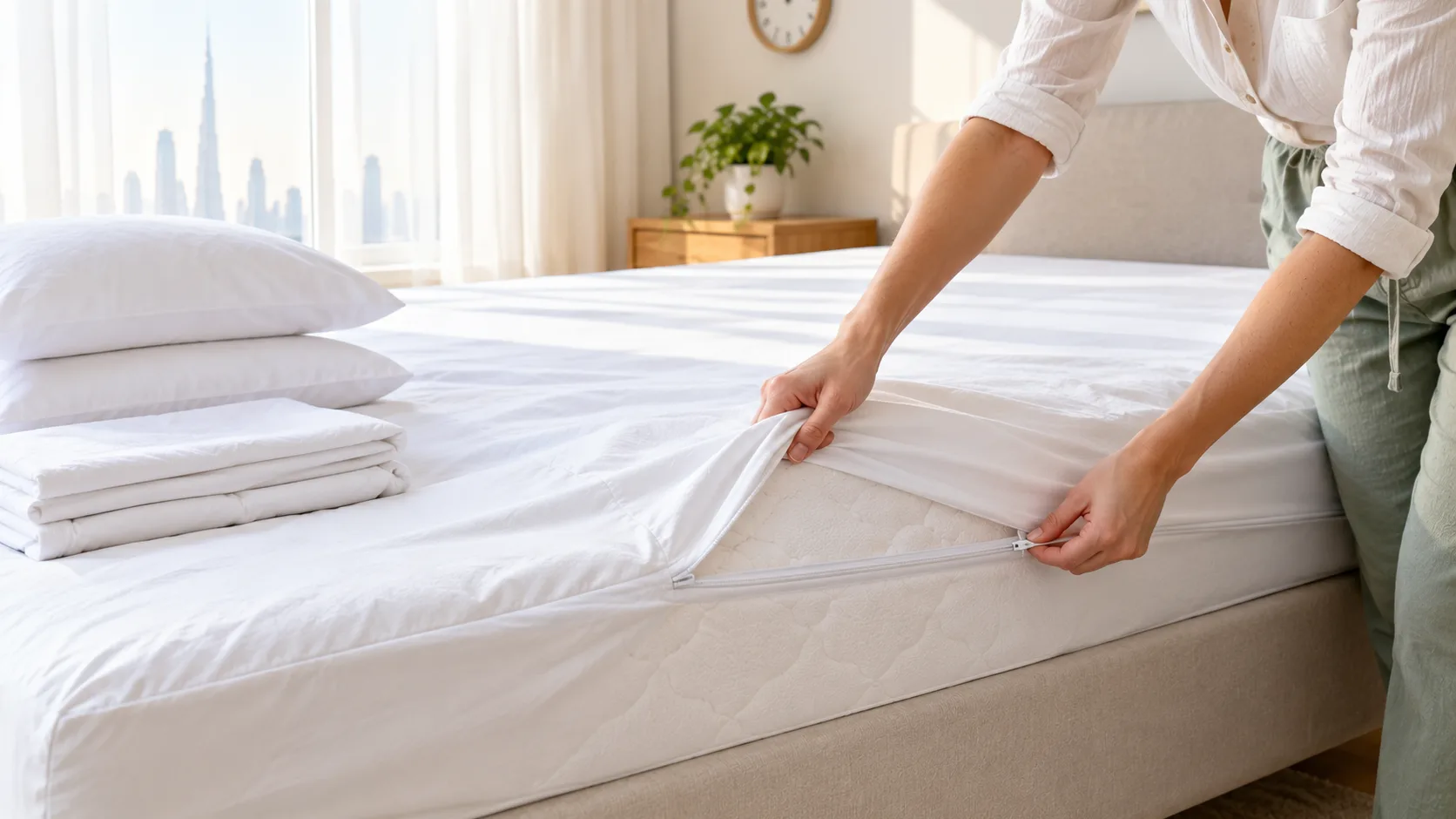
What to look for:
- A full zipped encasement, not a fitted topper that leaves five sides exposed.
- An allergen-proof or dust-mite-proof rating, stated by the manufacturer.
- Breathable fabric, so the bed does not become unbearable to sleep on.
- Matching pillow encasements, since pillows sit directly under your face.
Wash the encasement every couple of months, and leave it on permanently otherwise. Opening it up periodically to air the mattress defeats the point.
Step 6: Use Sunlight and Airflow
Dust mites dislike dryness, heat and light, and all three are free.
Where you can, stand the mattress on its side in a bright, dry room with a fan on it for a few hours. Direct sun is better still — UV light kills mites and the heat dries the surface out.
Does putting a mattress in the sun work in Dubai?
Yes, with one practical caveat. Summer sun here is more than hot enough, but a balcony also delivers a steady load of fine dust, and outdoor humidity on the coast is often higher than indoors with the AC running.
A realistic version: do it in the cooler months, keep it to a few hours, and brush the mattress down before bringing it back in. In summer, a bright room indoors with a fan and the AC on is the better option — the air in there is drier than the air outside.
Smaller washable items that cannot go in the machine can also be sealed in a bag and left in direct sun, which reaches temperatures mites do not survive.
What Does Not Work
A great deal of popular advice on dust mites is either useless or actively counterproductive. Saving you the effort:
Essential oils
Tea tree, eucalyptus and lavender are widely recommended and have some effect in a laboratory dish at concentrations you would never reach by misting a mattress. Sprayed on a bed they will not meaningfully reduce a population, and they add moisture to the exact place you are trying to keep dry. They may also irritate the airways of the allergy sufferer you are trying to help.
Freezing
Freezing does kill dust mites, and for a soft toy or a small pillow it is a legitimate trick: seal it in a bag and leave it in the freezer for twenty-four hours. But it does not remove the allergen, which survives perfectly well, so you must wash the item afterwards anyway. And there is no practical way to freeze a mattress.
Steam cleaning
This one is genuinely mixed. Steam is hot enough to kill mites on contact, so the appeal is obvious. The problem is that it introduces moisture into a mattress that cannot dry quickly, and leftover damp in a humid climate creates conditions for mould and for the mite population to rebound stronger than before.
Done by hand at home, the risk usually outweighs the benefit. Done professionally with proper extraction, the moisture is pulled back out rather than left behind, which is a different proposition entirely.
Anti-mite sprays and powders
Products that claim to kill mites in a mattress have to penetrate the depth of the foam to do anything, and consumer sprays do not. Most treat the top few millimetres. They are no substitute for washing, encasing and controlling humidity, and some leave a residue you then sleep against.
How to Get Rid of Dust Mites in a Mattress for Good
Here is the uncomfortable truth, stated plainly: you cannot eliminate them entirely. Any guide promising a dust-mite-free mattress is selling something. Mites exist in every home on earth that has soft furnishings and people in it, and a mattress in use will always carry some population.
What you can do is reduce that population heavily and, more importantly, cut the amount of allergen reaching you. That is what your symptoms actually respond to. Ranked by how much difference each measure genuinely makes:
- 1. A zipped allergen-proof encasement. The most evidence-backed single measure. It does not reduce the colony at all — it simply puts a barrier between the colony and you.
- 2. Humidity below 50%. The only thing that reduces the population itself, rather than managing it.
- 3. Weekly hot washing of bedding at 60°C. Kills what is in the washable layer and strips out allergen.
- 4. Regular HEPA vacuuming. Removes surface allergen. Must be repeated, because it does not reach the mites.
- 5. Professional deep cleaning once or twice a year. Resets the accumulated load that home methods cannot reach.
- 6. Reducing soft furnishings and clutter in the bedroom.
- 7. Sunlight and airing, useful and free, but a supporting measure rather than a main one.
Notice that two of the top three are not cleaning at all. If you are trying to work out how to clean a mattress of dust mites and getting nowhere, that is usually why — the problem is being treated as a cleaning task when it is mostly a barrier and humidity task. The same reasoning applies to getting rid of mites in a bed generally: the frame, the base, the pillows and the bedding all matter alongside the mattress itself.
For a mattress with years of accumulated allergen in it, the sensible sequence is to reset it once with professional mattress cleaning, then encase it and hold the humidity down so it never builds back up.
Dust Mites in the Bed Frame and the Rest of the Bedroom
Treating only the mattress leaves a reservoir that will repopulate it.
Work outwards:
- Wipe down the bed frame, slats and headboard with a damp cloth, including the underside.
- Vacuum under the bed properly — it is usually the dustiest part of the room.
- Wash or replace old pillows. Pillows accumulate allergen fast and are cheap to replace.
- Reduce soft clutter: cushions, soft toys, fabric storage boxes and piles of clothing all hold mites.
- Wash curtains, which trap bedroom dust continuously.
- Vacuum carpets and rugs weekly with a HEPA machine.
Curtains are the commonly missed one, partly because taking them down is a job in itself — curtain and blinds cleaning in place handles that without removing them. Bedroom carpets and rugs hold a comparable load to the mattress and benefit from carpet and rug cleaning, and if there is an armchair or sofa in the room, sofa cleaning applies the same principle to upholstery.
Where the whole bedroom needs resetting at once, this is usually folded into apartment deep cleaning rather than booked piece by piece.
Why Dust Mites Thrive in Dubai Homes
The local picture is more mixed than people assume, and worth understanding because it changes what you should prioritise.
- High outdoor humidity on the coast, frequently well above the 50% threshold for much of the year.
- Warm temperatures year-round, so there is no cold season to knock the population back.
- Sealed, air-conditioned rooms with limited fresh-air exchange, so allergen accumulates indoors.
- Fine desert dust settling constantly, adding to the overall load in bedding and carpets.
- Humidity spikes whenever the AC is switched off — in an empty apartment, overnight in a guest room, during a power cut.
- Wall-to-wall soft furnishings in many villas and apartments, giving mites more habitat.
The one thing working in your favour is the air conditioning itself, which dehumidifies as it cools. Used consistently it keeps bedrooms in a range mites struggle with. That also means a bedroom where the AC is used sparingly or switched off for long stretches is a considerably better home for them than one that is cooled steadily.
It is worth noting that if dusty air is being circulated around the home, the bedroom is receiving a continuous supply of material regardless of how well you clean the bed — which is where AC duct cleaning and sanitisation becomes relevant to an allergy problem rather than just an airflow one.
Dust Mites, Allergies and Asthma
Dust mite allergy is one of the most common causes of year-round allergic rhinitis, and it is a recognised asthma trigger. For an asthmatic, reducing exposure is not a comfort measure — it can affect how often symptoms occur.
Children are worth particular attention, because they spend longer in bed than adults and because their bedrooms tend to hold more soft toys and fabric than anyone else’s.
Nothing here replaces medical advice. If symptoms are significant, allergy testing will tell you whether dust mites are genuinely the trigger before you rearrange a bedroom around them. What this guide covers is the exposure side, which is the part you control.
How Often Should You Do All This?
- Weekly: hot-wash all bedding at 60°C; vacuum bedroom carpets and rugs.
- Monthly: vacuum the mattress and the bed base; air the mattress.
- Every two months: wash the mattress encasement and the pillow encasements.
- Every few months: wash or replace pillows; wash curtains.
- Once or twice a year: professional mattress cleaning.
- Daily: keep an eye on the hygrometer and keep the room between 40% and 50%.
The weekly hot wash and the encasement carry most of the benefit. If the full list is unrealistic, those two are the ones to keep.
When Home Measures Are Not Enough
Consider professional help when:
- Allergy or asthma symptoms persist after several weeks of doing all of the above.
- The mattress has never been professionally cleaned and is several years old.
- You do not have a HEPA vacuum and are effectively redistributing allergen each time.
- Someone in the home has diagnosed dust mite allergy or asthma.
- The mattress smells musty, which suggests moisture and possibly mould as well as mites.
- You are moving into a property with a mattress of unknown history.
The practical difference is depth and extraction. Home vacuuming pulls allergen from the surface layer; professional mattress cleaning uses hot water extraction with industrial suction, which reaches further into the mattress, removes a far greater share of mites and accumulated allergen, and — importantly in this climate — extracts the moisture back out rather than leaving the mattress damp.
Where the problem extends past the bed into the room itself, home disinfection and sanitisation treats the wider space. And if the mattress has stains or odour as well as an allergen load, that is a separate job with a different method — we cover it in how to remove urine smell from a mattress.
How to Remove Dust Mites from a Mattress: The Short Version
- Dust mites do not bite. If you have bites, you are dealing with something else.
- You cannot eliminate them completely. The realistic goal is to reduce them and cut your exposure.
- Hot-wash all bedding weekly at 60°C, or wash cool and tumble dry hot.
- Vacuum the mattress monthly with a HEPA vacuum, slowly, including the seams.
- Keep bedroom humidity between 40% and 50%. This is the most effective control there is.
- Fit a zipped allergen-proof encasement on the mattress and the pillows, and leave it on.
- Skip the essential oils, the anti-mite sprays and home steam cleaning.
- Treat the whole bedroom, not just the bed.
For a mattress that has been in use for years, home measures start from a difficult position — there is a great deal of accumulated allergen below the surface before you begin. Care N Clean provides professional mattress cleaning in Dubai using hot water extraction and sanitisation, which removes dust mites, their waste and embedded allergens from the depth of the mattress and leaves it dry enough to sleep on the same day.