
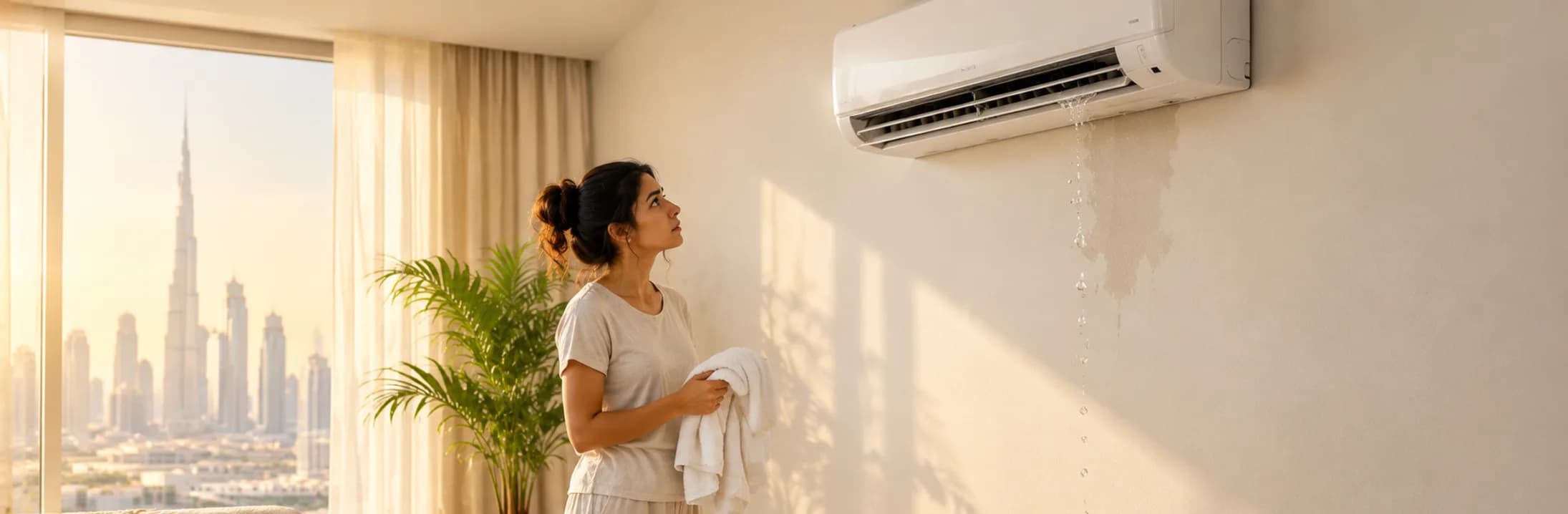
Finding a puddle under the indoor unit, a damp patch spreading across the ceiling or steady drips landing on the floor is alarming, and the first question is always the same: why is my AC leaking water inside the house?
Here is the part that catches most people out. Your air conditioner is supposed to produce water. A split unit running on a humid Dubai afternoon can pull several litres of moisture out of the air in a single day. That water is normal. What is not normal is where it ends up. When an AC is leaking water indoors, the moisture is being produced exactly as designed but is no longer draining away as designed.
That distinction matters, because it narrows the problem down quickly. An air conditioner leaking water is almost never a mystery fault. It is a drainage problem, a freezing problem or an installation problem, and each of those has visible symptoms you can identify before anyone opens the unit.
This guide explains where the water comes from, the eight reasons an aircon leaks water inside, how to tell AC water from a plumbing leak when it is coming through a ceiling vent, what to do in the first ten minutes, and which faults genuinely need a technician.
Why Is My AC Leaking Water? The Short Answer
Your AC removes heat and moisture from room air. The moisture condenses on the cold evaporator coil, runs down into a drain pan, and leaves the building through a drain pipe. A leak means that chain has broken somewhere.
The most common reasons an AC is leaking water inside the house are:
- A blocked condensate drain line: by far the most frequent cause in Dubai.
- A dirty filter or frozen evaporator coil: ice melts faster than the pan can drain.
- Low refrigerant or a gas leak: causes the coil to freeze in the first place.
- A cracked, rusted or overflowing drain pan.
- A disconnected or sagging drain pipe inside the ceiling void.
- An indoor unit that is not level, usually an installation fault.
- A failed condensate pump, where one is fitted.
- Uninsulated ducts or pipework sweating in humid air.
The table below matches what you are seeing to the most likely cause.
| What you notice | Most likely cause | What it usually needs |
|---|---|---|
| Water dripping from the AC indoor unit, front edge | Blocked drain line or overflowing pan | Drain clearing |
| Water only after switching the unit off | Frozen coil thawing | Cleaning or gas check |
| Water leaking from a vent in the ceiling | Blocked drain or sweating duct | Diagnosis |
| Ice on the pipes, then water later | Restricted airflow or low refrigerant | Cleaning or repair |
| Water running down the wall behind the unit | Unit not level or pipe pulled loose | Repair or reinstallation |
| Drips only on very humid days | Missing or damaged insulation | Repair |
| A brown stain on the ceiling that keeps growing | Hidden drain leak above the ceiling | Urgent inspection |
| Water with no AC running at all | Plumbing, not HVAC | Plumber |
Where the Water in Your AC Actually Comes From
Understanding this takes thirty seconds and it rules out half the worries people arrive with.
Warm indoor air is drawn across the evaporator coil, which sits well below the dew point. Moisture in that air condenses onto the cold metal in exactly the way a cold glass sweats on a summer day. The droplets run down the fins into a sloped drain pan underneath, then out through a drain line to a drain point, a balcony or an outdoor discharge.
So condensation is the system working correctly. Dehumidification is half of what an air conditioner does, which is why a properly working unit makes a room feel dry as well as cool.
The water becomes a problem only when it cannot leave. If the drain is blocked, the pan is cracked, the pipe has come loose or the coil has frozen into a block of ice, that same water finds the nearest way out — through the front of the indoor unit, down the wall, or into the ceiling void above you. An air conditioner leaking water into the room is condensation that has been diverted, not condensation that should never have existed.
1. A Blocked Condensate Drain Line
If you only read one section, read this one. A blocked drain line is the single most common reason for an aircon leaking water indoors, and in Dubai it is close to a seasonal certainty on units that are never serviced.
The drain line is a narrow pipe, often no wider than a finger. It carries water that is slightly warm, perfectly dark and constantly damp, which makes it an ideal place for algae, biological slime, dust and lint to build into a plug. Once that plug forms, water backs up into the drain pan, the pan fills, and it overflows.
Signs of a blocked drain line:
- Water dripping from the AC indoor unit along its lower front edge.
- A gurgling sound from inside the unit while it runs.
- A musty or sour smell that gets stronger when the AC starts.
- No water at all coming out of the outdoor drain point when the unit has been running.
- The unit shutting itself down, if it has a float switch fitted.
That last point is worth knowing. Many units include a safety float switch that cuts the system off when the pan fills. If your AC keeps switching itself off during humid weather, a blocked drain is a strong suspect, and the shutdown is protecting your ceiling rather than malfunctioning.
Clearing a drain line properly means flushing the full run, not just the visible end, and treating the growth that caused the blockage. It is usually a quick job, and it is included in a professional AC cleaning service. If the line has blocked repeatedly or the blockage is deep in the ceiling run, it needs AC repair and diagnosis to find out why it keeps recurring.
2. A Dirty Air Filter and a Frozen Evaporator Coil
This is the cause people least expect, because the symptom is water but the fault is ice.
When the filter is clogged, airflow across the evaporator coil drops. Less warm air passing over the coil means the coil gets colder than it should, falls below freezing, and the condensation on it turns to frost instead of running off. Over hours that frost becomes a sheet of ice.
The ice itself causes no leak while the unit is running. The moment you switch the AC off, or the moment the ice gets thick enough to break away, all of it melts at once. The drain pan is sized for a steady trickle, not a sudden release, so it overflows and water pours out of the indoor unit.
The giveaway pattern is unmistakable once you know it: cooling gets steadily weaker through the day, and the leak appears after the unit is turned off.
What to look for:
- Visible frost or ice on the coil or the copper pipework.
- Weak airflow from the vents before the leak started.
- A large volume of water at once rather than a slow drip.
- A filter that light will not pass through when you hold it up.
If you see ice, switch the AC off and leave it off until it has thawed completely. Running a unit with a frozen coil strains the compressor, which is the most expensive component in the system. Once thawed, clean or replace the filter. If the coil fins themselves are matted with dust, surface cleaning will not reach them and the unit needs an AC coil chemical wash to restore proper airflow and heat transfer.
3. Low Refrigerant or a Gas Leak
Low refrigerant produces exactly the same freezing behaviour as a dirty filter, by a different route. When the gas charge drops, pressure in the evaporator coil falls, the coil runs colder than designed, and it ices up. The ice melts, the pan overflows, and you have an HVAC unit leaking water.
The way to tell this apart from a filter problem is the history. A filter blockage builds over weeks and clears when you clean it. A refrigerant leak gives you cooling that has been fading gradually for a month or more, a filter that is reasonably clean, and ice that comes straight back after thawing.
Other indicators of low gas:
- Air that is mildly cool rather than cold, at every setting.
- Ice forming on the thinner copper pipe at the outdoor unit.
- A hissing or bubbling sound near the indoor unit.
- Higher electricity bills with worse cooling than last season.
Refrigerant is not consumed in normal operation, so a low charge always means a leak somewhere. Simply topping it up buys a few months and nothing more. The leak has to be located and repaired first, then the system recharged to the manufacturer’s specification, which is how Care N Clean handles AC gas refill and top-up after a proper diagnosis.
4. A Cracked, Rusted or Overflowing Drain Pan
The drain pan sits beneath the evaporator coil and catches everything that condenses on it. On older units, particularly those ten years and up, the pan is a common failure point.
Metal pans corrode from years of standing water. Plastic pans become brittle in constant heat and crack. Either way the water escapes before it ever reaches the drain line, which is why a pan fault often looks like a leak with no obvious blockage behind it.
Typical signs:
- A steady leak even though the drain line is clear and water does discharge outside.
- Visible rust, staining or a hairline split in the pan.
- Water appearing at one specific corner of the indoor unit.
- The leak continuing after the drain has been flushed.
Minor cracks can sometimes be sealed, but on a corroded pan that is a short-term measure. Replacement is usually the sensible route, and on a unit that is already well past its service life it is worth comparing the cost against AC installation and replacement before spending on repairs.
5. A Disconnected, Sagging or Damaged Drain Pipe
In ducted systems and concealed units, the drain line runs for several metres above the ceiling before it reaches a discharge point. A lot can go wrong along that run, and none of it is visible from the room.
Common failures include a pipe that has worked loose at a joint, a flexible section that has sagged into a U shape and now holds standing water, a line crushed during other ceiling work, and a run installed with too little fall so water never flows properly.
Suspect the pipe run when:
- The indoor unit itself is dry but there is a damp patch in the ceiling nearby.
- Water appears some distance from the AC rather than directly beneath it.
- The leak started after recent work in the ceiling void.
- A brown stain is spreading across gypsum board.
This one should not be left. Water sitting on a gypsum ceiling weakens it quickly and ceilings do collapse. If a section has already sagged, stained through or gone soft, it will need making good with gypsum and ceiling repair work once the leak itself has been stopped.
6. An Indoor Unit That Is Not Level
The drain pan relies on gravity. It is designed with a slight tilt towards the drain outlet, and if the unit is mounted even slightly off, water pools at the wrong end and spills over the edge instead of draining.
This is an installation fault, and it has a distinctive signature: the unit leaks from the day it is fitted, or from the day it is moved, rather than developing a leak after years of normal service.
It can also appear later if wall fixings have loosened, if a heavy unit has gradually pulled away from its bracket, or if the wall itself has been disturbed. The fix is to re-level and re-secure the unit correctly, which is straightforward when done by someone with the right bracket and the right fixings for the wall type.
7. A Failed Condensate Pump
Where a unit sits below its drain point, or where there is no gravity route outside, a small condensate pump lifts the water out instead. Apartments and concealed ceiling units frequently have one.
Pumps fail. The motor burns out, the float jams with slime, the discharge tube blocks or the power supply is interrupted. When the pump stops, water has nowhere to go and the pan overflows exactly as it would with a blocked line.
The clue is sound. A working condensate pump makes a short, quiet whirring noise every few minutes as it empties. Silence from a unit that used to click and hum, combined with a leak, points straight at the pump. This is a replacement part rather than a cleaning job, and it is identified during AC repair and diagnosis.
8. Sweating Ducts and Missing Insulation
Sometimes the water never came from the drain system at all. Cold ductwork and cold refrigerant pipes running through warm, humid space will condense moisture on their outer surface, in the same way the coil does inside the unit. Proper insulation prevents it. Damaged, compressed or missing insulation does not.
This is the usual explanation when water appears along a duct run rather than at the unit, when drips are worst in August and absent in winter, or when the volume is small but persistent and nothing is blocked.
Ducts that are both poorly insulated and heavily contaminated often come with a musty smell and dust blowing from the grilles, in which case AC duct cleaning and sanitisation addresses the contamination while the insulation itself is repaired.
Water Leaking From a Vent in the Ceiling: AC or Plumbing?
This deserves its own section, because it is the situation that worries people most and the one most often misdiagnosed. Water coming out of a ceiling vent, air grille or light fitting can come from the AC or from a pipe, and the response is different for each.

It is probably the AC if:
- Water appears only while the AC is running, or shortly after it stops.
- It stops within a day of switching the AC off completely.
- It is worse on hot, humid days and absent in cooler weather.
- The water is clear and odourless, or smells faintly musty.
- The drip is at or near an air grille rather than anywhere else.
It is probably plumbing if:
- Water keeps coming with the AC switched off for a full day.
- It is unaffected by the weather or the time of day.
- It coincides with someone using a bathroom or kitchen above.
- The water is discoloured or smells unpleasant.
- Water pressure in the property has changed.
The test is simple and costs nothing: switch the air conditioning off entirely for twenty-four hours and watch. If the leak stops, it is the AC. If it continues, it is a water supply or waste pipe and needs a plumber, not an HVAC technician — Care N Clean covers that through leak and pipe repair.
In an apartment, add one more step. If the leak persists with your own AC and plumbing idle, the source may be the unit above yours, and your building management needs to know early rather than after the ceiling has come down.
What to Do in the First Ten Minutes
Before anything else, limit the damage. These steps are safe to do yourself.
- Switch the AC off at the remote and at the breaker. Electricity and water in the same unit is the one genuine safety risk here.
- Put a container under the drip and towels around it to protect flooring.
- Move furniture, rugs and electronics out from under the leak.
- Photograph the leak and any stain before you clean it up, for your landlord, your insurer or the technician.
- Check the filter and look for ice on the coil or pipes.
- Check whether water is discharging outside at the drain point while the unit runs.
- Do not use the AC again until the cause is known, if the leak is more than an occasional drop.
What not to do: do not poke wire or a skewer into the drain line, which punctures pipework and turns a blockage into a hidden leak; do not run the unit with a container underneath as a long-term arrangement; and do not ignore a ceiling stain because the drip has stopped, since the water above it has not necessarily gone anywhere.
Is It Dangerous to Run an AC That Is Leaking Water?
A single drop of condensation on a humid day is not an emergency. A genuine, repeating leak is, for three reasons.
Electrical risk. The indoor unit contains a control board, a fan motor and mains wiring. Water tracking into any of those can short the board or create a shock hazard.
Structural damage. Gypsum ceilings, which are standard across Dubai apartments and villas, lose strength fast when they stay wet. A stain that keeps growing is a warning, not a cosmetic issue.
Mould and air quality. Warm, damp, dark cavities are ideal for mould, and in a ceiling void the growth is well established before anyone sees it. Because the air handling system runs through that same space, spores get distributed around the property. Anyone in the home with asthma or allergies will feel it before the leak is ever found.
There is also the cost argument. A blocked drain cleared early is a minor service call. The same blockage left for a season can mean a replaced ceiling section, repainting, mould treatment and a damaged control board.
Why AC Water Leaks Are More Common in Dubai
If you have lived somewhere with a milder climate and never had this problem before, the difference is not your imagination.
- Very high humidity for much of the year means units condense far more water per hour than they would elsewhere.
- Near-continuous running keeps drain lines permanently wet, which is exactly what algae and slime need.
- Fine desert dust loads filters quickly, and restricted airflow is the route to a frozen coil.
- Concealed ceiling units are common, so leaks develop out of sight and show up as ceiling damage rather than a visible drip.
- Long horizontal drain runs above ceilings are more prone to sagging and blockage than a short external pipe.
- Construction dust in newer communities finds its way into both the unit and the drain system.
The practical consequence is that drain lines here need clearing more often than any manufacturer manual assumes, and a yearly check before summer prevents most of what this article describes.
Is It a Cleaning Job or a Repair Job?
Knowing which one you need stops you paying for a service that was never going to fix the fault.
It is probably a cleaning issue if:
- The filter is visibly dirty and airflow has been weak.
- There is a musty smell along with the water.
- The unit has not been serviced in a year or more.
- Nothing is discharging from the outdoor drain point.
- The leak started gradually rather than overnight.
It is probably a repair issue if:
- The drain has been flushed and the leak came back.
- The pan is cracked, rusted or split.
- Ice returns within a day of thawing and cleaning.
- The condensate pump has gone silent.
- Water is appearing away from the unit, inside the ceiling.
- The unit is also failing to cool properly.
When the symptoms do not point clearly one way, an AC diagnosis is the cheaper first step. It establishes the actual fault, and it avoids the common outcome of paying for a cleaning that leaves a refrigerant leak or a cracked pan untouched.
How to Stop Your AC Leaking Water Again
Nearly every cause in this article is preventable, and prevention is a fraction of the cost of ceiling repairs.
- Clean or replace the filter monthly through the Dubai summer, not twice a year.
- Have the drain line flushed and treated at every service, before it blocks rather than after.
- Service the system before summer begins, while technicians are still available at short notice.
- Check the outdoor drain point occasionally during humid weather — water should be discharging.
- Act on the early signs: a gurgle, a musty smell or a faint stain are all cheaper than a flood.
- Keep pipe and duct insulation intact and have damaged sections replaced rather than taped.
- Have the drain pan inspected on any unit older than about eight years.
For properties where the AC runs most of the year, an AC annual maintenance contract puts the drain flush and filter work on a schedule, so it happens before the blockage rather than after the ceiling is stained.
When Should You Call a Technician?
Switch the unit off and book a professional if any of these apply:
- The leak returns after you have cleaned the filter and let the unit thaw.
- Water is coming from the ceiling rather than from the unit itself.
- There is a stain on gypsum board, or a section feels soft or sagging.
- Ice keeps forming on the coil or pipework.
- The AC is leaking and also not cooling properly.
- The unit trips the breaker or shuts itself off repeatedly.
- You can smell mould, or anyone in the home has developed a cough or allergy symptoms.
- The drain line has blocked more than once in the same year.
That last one is worth emphasising. A drain that blocks repeatedly is telling you something else is wrong — a pipe with insufficient fall, a sagging section holding water, or a system producing far more condensate than it should. Clearing it again treats the symptom and the leak will be back.
Why Is My AC Leaking Water? The Final Answer
If your AC is leaking water inside the house, the water itself is normal. Your air conditioner is meant to pull moisture out of the air, and in Dubai it pulls out a lot of it. The fault is in the drainage, not in the condensation.
Work through it in this order:
- Switch the unit off at the breaker and protect whatever is underneath it.
- Check the filter and look for ice — water that appears after switching off is a thawing coil.
- Check whether anything is discharging at the outdoor drain point. Nothing means a blocked line.
- If water is coming through the ceiling, turn the AC off for a day to separate an AC leak from a plumbing leak.
- Blocked drains, dirty filters and dusty coils are cleaning work. Cracked pans, failed pumps, low gas and damaged pipework are repair work.
- Never leave a ceiling stain to dry out on its own.
Care N Clean provides AC repair and diagnosis in Dubai, alongside AC cleaning, coil chemical washing, drain clearing, gas refill and duct services, so the cause of the leak is identified before any work is quoted.