
Guarantee. Free cancellation up to 12 hours before the visit. If anything is not right, tell us within 48 hours and we re-do the affected work at no extra cost.
Dubai’s villa communities give subterranean termites exactly what they need: irrigated gardens keeping the soil moist, concrete slabs with expansion joints and service penetrations to tunnel through, and timber doors, skirting, wardrobes, kitchen cabinets, parquet and pergolas to feed on. Subterranean termites travel from the soil through mud tubes on foundations and walls and eat timber from the inside, so a door frame can look fine until a screwdriver goes straight through it.
Drywood termites arrive inside imported furniture and live in the wood itself, leaving piles of fine pellets. Infestations are most common in older villa areas such as Jumeirah, Umm Suqeim, Al Barsha, Mirdif, Al Warqa, Mushrif, The Springs and The Meadows, but any ground-floor unit with timber and a garden can be affected. Pre-construction anti-termite treatment is a standard requirement in Dubai building specifications because retrofitting a barrier costs several times more.
Pest Control
Professional termite treatment to control infestations, protect your property, and address termite activity with targeted solutions.
Replacement of damaged timber, joinery or flooring (we can refer a carpenter), and monitoring bait stations unless quoted as part of a termite management contract.
Jumeirah, Umm Suqeim, Al Barsha, Al Barsha South, Mirdif, Al Warqa, Mushrif, Al Quoz, The Springs, The Meadows, Arabian Ranches, Dubai Hills, Jumeirah Village, Palm Jumeirah, Bur Dubai, Deira, Al Nahda, Dubai Silicon Oasis and Dubai Investments Park. We also provide termite control in Sharjah, Ajman, Abu Dhabi and Ras Al Khaimah.
It depends on the method and the area treated. The inspection fee is credited against the treatment. A full post-construction barrier for a villa is quoted by perimeter and slab size, and pre-construction treatment is priced per square foot. Published Dubai averages range from AED 500 for a small spot treatment to AED 5,000 for a whole villa.
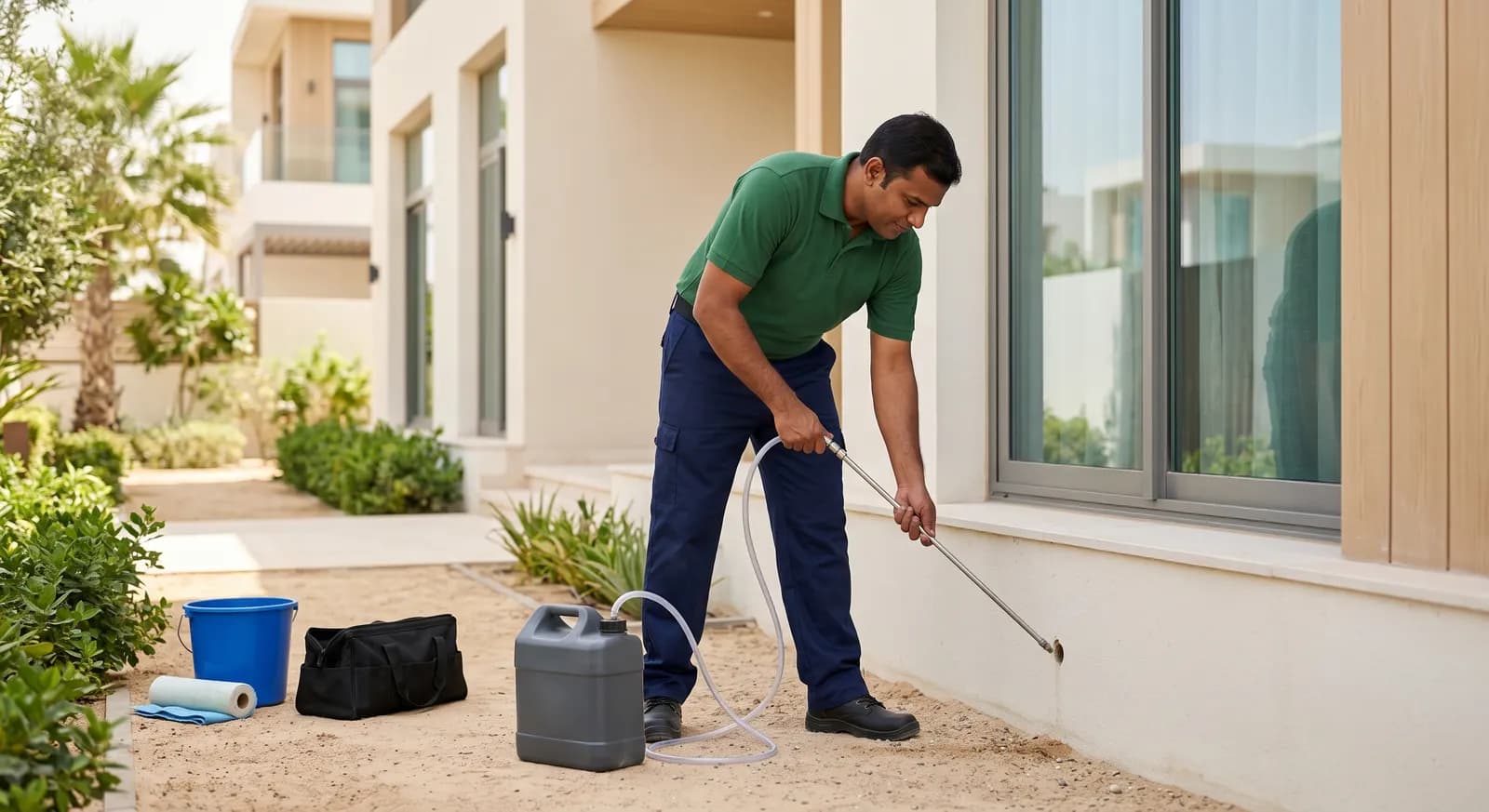
For subterranean termites, a non-repellent chemical barrier around and under the structure, because workers carry the termiticide back to the colony. For a single infested item or area, spot treatment or wood injection is enough. For drywood termites in furniture, item-by-item wood treatment. The inspection tells you which applies.
It is soil treatment under the slab and along foundations before the floor is poured, creating a barrier that lasts for years. It is a standard requirement in Dubai building specifications for new villas and buildings and is far cheaper than treating a finished structure.
No. Fumigation (tenting a building with gas) is rarely used in Dubai and does not stop subterranean termites returning from the soil. Chemical barriers and injection are the standard methods here; fumigation is reserved for isolated drywood infestations in movable items.
Heat treatment is not effective against subterranean termites, whose colony is in the soil. For drywood termites in furniture we treat the item directly; ask us if you need a specific piece treated.
Spot treatment and wood injection take one to three hours. A full villa barrier takes a day. Pre-construction treatment is scheduled around your slab pour and usually takes a few hours per stage.
The termiticides are applied into soil, slab and timber rather than sprayed in living spaces, and are Dubai Municipality-approved. You can usually stay at home; we advise keeping children and pets away from treated areas until they are dry.
A properly installed barrier protects the structure for years and is covered by our warranty. Recurrence usually comes from a breach (new landscaping, an extension, a cracked slab), which is why we re-inspect within the warranty period.
Supermarket sprays kill the termites you can see and push the rest deeper into the structure. Effective termite control needs a professional termiticide applied into the soil and timber at the right concentration, which in Dubai must be done by a licensed contractor.
Yes. Warehouses, hotels, schools, retail and residential buildings, including annual termite management contracts with scheduled inspections and reports.